





Software
Who actually writes it?
AI drafts, a separate review decides
A person decides what is built. Every change is independently reviewed and tested before it ships.
Anyone can ask AI for an app. Making one that is safe, that fits your business and that grows with it takes specialists. We are the AI specialists, for businesses anywhere in the world.
Turn it into a
Every business has a spreadsheet like this one. Press a button to see what replaces it.
| A | B | C | D | E |
|---|---|---|---|---|
| Mrs Okafor | 09:00 | Cut+colour | 65 | paid |
| D. Whitlow | 10:30 | Trim | 18 | ?? |
| same lady | 12:00 | colour | 65 | cash? |
| Priya (resc) | 2pm | Cut | 22 | paid |
| 15:15 | Beard | 12 | unpaid | |
| J Mensah | 16:00 | Cut+beard | 30 | paid |
Today
Tuesday, 6 jobsOutstanding
3 overdueBelow minimum
reorder before FridayBuilt by the same people with the same tools. Most are free, so try one now.
Secure and very fast, and hosted by us.
We build both, on a base already written and tested.
Built around your business today, and changed as your business changes. A fixed quote in writing, with a completion date.
What we buildHosting, contact form and live chat included. No cookies, no consent banner.
What comes with oneAsking AI for an app is the easy part. Knowing what it got wrong is the job.
The repetitive part takes minutes of machine time, not weeks.
Every change goes through 42 separate checks before it ships. Every finding is fixed, even the ones that look minor, because a few minor faults put together can make a serious one.
If we misjudge how long it takes, that is our problem, not yours.
In your own words. No specification needed.
Fixed, with a completion date, in writing.
Log in early and say what is wrong.
The code and the data are yours.
Twenty-five answers in five topics, in plain words.
AI drafts, a separate review decides
A person decides what is built. Every change is independently reviewed and tested before it ships.
Yes, in full
With plain documentation and an export for everything. If we walked away tomorrow, somebody else could pick it up.
Written down, with a completion date
The quote is agreed before work starts. It changes only if you ask for something that was not in your description, and we tell you first.
You take everything
All exportable, and no notice period. For software, the code and data are yours in full.
No, nothing to consent to
There is nothing to consent to. We set no cookies and collect no personal data.
Global, and it makes no difference
Registered in England and Wales, with everything done remotely. Where you are makes no difference to how quickly we answer.
No specification needed, and usually an answer back the same week.
Tell us what you needMention Christmas in the second week of September and most people groan. The shops have already put the tins out, the summer has only just gone, and nobody wants to think about it. But if your business earns a good part of its year between November and the end of December, September is exactly when the website work needs to happen. Not because customers are searching for Christmas yet, but because you will not have a spare hour to do it in November.
This is the checklist we run through with our own clients each September. Very little of it is technical. Most of it is deciding things now that you would otherwise decide in a panic later, and writing them down where customers can see them.
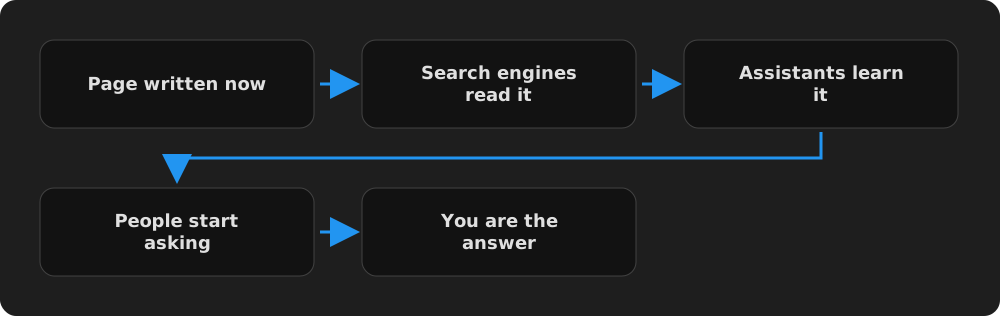
Three reasons. First, search engines and AI assistants take time to notice a new or changed page. A Christmas page that goes up in September has weeks to be read, understood and trusted before anyone asks about it. One that goes up on the first of December is competing with everybody else's and has no history.
Second, the light. If you sell anything that needs a photograph, September afternoons are long, bright and warm enough to work in. By November you are photographing at half past three in the gloom, and it shows. Take the pictures now, even of things you will not sell until December.
Third, your own time. In our experience the owners who leave it to November either do not do it at all, or do it badly at eleven at night. September has slack in it. Use it.
Each of these is a question a customer will ask in December. Decide the answer in September, put it on the website in plain text, and you will not have to answer it two hundred times by phone.
Do not be tempted to leave any of these as 'we will see'. A customer asking an assistant on their phone whether you are open on the twenty-seventh of December gets an answer from whoever has written it down. If that is not you, it is somebody else.
The most useful thing we build for a seasonal business is a Christmas page that exists all year and is simply hidden until it is needed. It holds the hours, the dates, the vouchers, the menu or the services, and a plain way to book or order. In September you write it and check it. In late October or early November you switch it on and link it from the home page. In January you switch it off again, and the address stays the same for next year, so everything search engines learnt about it is kept.
If your site cannot do that, the next best thing is a page you write now and publish on a date you choose, with a note in your diary to add the link. What you want to avoid is building it from scratch on the day it is needed.
Keep the page plain. A heading that says Christmas and the year. Hours as a list. Dates as dates. Prices as numbers. One clear way to act: book, order, buy a voucher, ring. No snow animation, no music, no countdown. The people reading it are busy and often on a phone in a queue.
Whatever you will be selling or showing in December, photograph it this month. Products, gift sets, the dining room laid for a party, the salon, the workshop, the van. Use a window and the afternoon light, not the ceiling lamp. Take more than you think you need, and take them at the size and shape your site uses so nothing has to be cropped awkwardly later. If you decorate for Christmas, you can photograph the decorated version in late November as a bonus, but the main set should be done while it is easy.
Check the pictures already on your site while you are at it. Anything with a summer sky, a beer garden or a sunhat in it should be swapped for something that looks right in the dark months.
Here is the timetable we use. Adjust it to your trade, but keep the order.
| When | What |
|---|---|
| September, weeks two to three | Decide hours, dates, vouchers, deposits, services; write the Christmas page; take photos |
| September, week four | Check the phone number, the form and the chat from a mobile; fix anything broken |
| October | Switch on vouchers if you sell them; mention Christmas bookings on the home page |
| Early November | Switch on the Christmas page; link it from the home page and the contact page |
| Late November | Add last order dates to the top of the home page; check stock or capacity |
| Mid-December | Put festive hours where nobody can miss them; set the out-of-hours reply on chat |
| First week of January | Switch the page off; put January hours up; write down what to change next year |
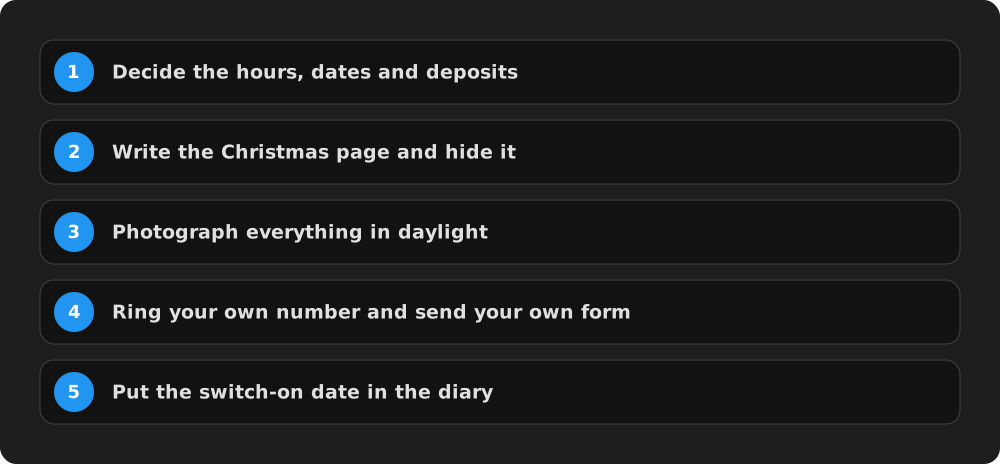
Decide it in September, when nobody is upset and there is still light to photograph by.
The last line of the table matters more than it looks. In the first week of January, while it is fresh, write down what went wrong: the question you were asked most, the date people missed, the voucher amount nobody wanted. Next September, that note is the whole plan.
None of this needs a new website, and most of it needs no designer at all. It needs an hour of decisions, an afternoon with a camera, and a page written in plain words. For the sites we look after, the hidden Christmas page and the switch-on date are part of the standard setup, but any site can do the same. Do it now, while September is quiet, and December will be busy in the way you want it to be.