Software
Who actually writes it?
AI drafts, a separate review decides
A person decides what is built. Every change is independently reviewed and tested before it ships.
Anyone can ask AI for an app. Making one that is safe, that fits your business and that grows with it takes specialists. We are the AI specialists, for businesses anywhere in the world.
Turn it into a
Every business has a spreadsheet like this one. Press a button to see what replaces it.
| A | B | C | D | E |
|---|---|---|---|---|
| Mrs Okafor | 09:00 | Cut+colour | 65 | paid |
| D. Whitlow | 10:30 | Trim | 18 | ?? |
| same lady | 12:00 | colour | 65 | cash? |
| Priya (resc) | 2pm | Cut | 22 | paid |
| 15:15 | Beard | 12 | unpaid | |
| J Mensah | 16:00 | Cut+beard | 30 | paid |
Today
Tuesday, 6 jobsOutstanding
3 overdueBelow minimum
reorder before FridayBuilt by the same people with the same tools. Most are free, so try one now.
Secure and very fast, and hosted by us.
We build both, on a base already written and tested.
Built around your business today, and changed as your business changes. A fixed quote in writing, with a completion date.
What we buildHosting, contact form and live chat included. No cookies, no consent banner.
What comes with oneAsking AI for an app is the easy part. Knowing what it got wrong is the job.
The repetitive part takes minutes of machine time, not weeks.
Every change goes through 42 separate checks before it ships. Every finding is fixed, even the ones that look minor, because a few minor faults put together can make a serious one.
If we misjudge how long it takes, that is our problem, not yours.
In your own words. No specification needed.
Fixed, with a completion date, in writing.
Log in early and say what is wrong.
The code and the data are yours.
Twenty-five answers in five topics, in plain words.
AI drafts, a separate review decides
A person decides what is built. Every change is independently reviewed and tested before it ships.
Yes, in full
With plain documentation and an export for everything. If we walked away tomorrow, somebody else could pick it up.
Written down, with a completion date
The quote is agreed before work starts. It changes only if you ask for something that was not in your description, and we tell you first.
You take everything
All exportable, and no notice period. For software, the code and data are yours in full.
No, nothing to consent to
There is nothing to consent to. We set no cookies and collect no personal data.
Global, and it makes no difference
Registered in England and Wales, with everything done remotely. Where you are makes no difference to how quickly we answer.
No specification needed, and usually an answer back the same week.
Tell us what you needWhen you look at your website you see the whole thing at once: the photo across the top, the colours, the logo, the nice spacing, the button that goes green when you hover. When an AI agent visits, it sees none of that. It gets the words, in the order they appear in the code, with a few labels telling it what each part is. That is all.
This matters more every month, because AI agents are now visiting small business websites on behalf of real people. Someone asks an assistant to find a dog groomer that does large breeds and is open on Saturdays, and the assistant goes and reads a dozen websites in a few seconds to answer. What it can read, it can recommend. What it cannot read might as well not be there.
Strip away everything visual and a web page is a list of text with labels. An agent reads roughly this:
Notice what is missing. No pictures. No colours. No layout, so it does not know that the phone number is in a big box on the right. No animation. Nothing that only appears when you click, tap, scroll or hover. It reads the page the way a very fast, very literal person would read it down the phone to you.
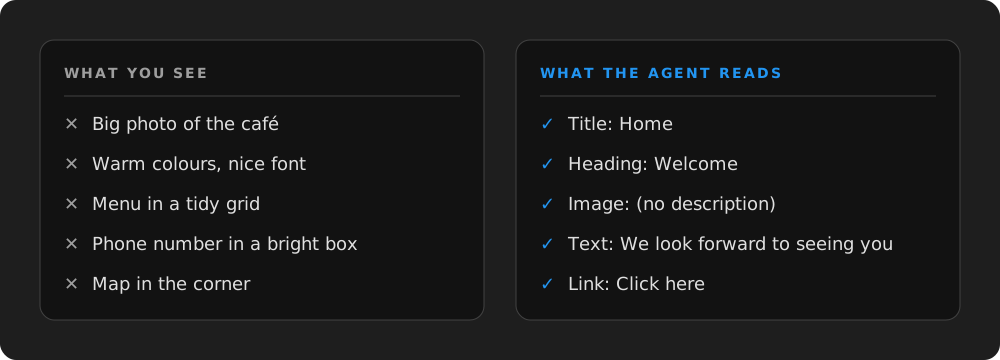
The commonest problem is not bad writing but invisible writing. Information that a person can see perfectly well and an agent cannot reach at all. The usual places it hides:
Each of these has an easy fix, and it is the same fix every time: put the words on the page as words. A menu as a list. Hours as a sentence. The address as text under the map. A description on every picture that says what it shows.
If it is only in a picture, it is not on the page.
Because the agent reads from the top, what comes first carries weight. If the first heading is "Welcome" and the first paragraph is about how passionate you are, it has to read a long way before it learns you are a bakery in Hexham. Put the plain facts early: what you are, where you are, what you do. The warm paragraph can come after.
Headings are the skeleton. An agent uses them to work out which part of the page answers which question. A page with one heading and a wall of text underneath is hard to read. A page with a heading for each thing people ask about, "Prices", "Where we are", "Opening hours", "What to bring", is easy. This is also, not by coincidence, easier for a person on a phone.
Link text is the same. An agent follows links to learn more, and it decides which to follow by the words. "Find out more" three times on a page gives it nothing to go on. "See the full menu", "Book a table", "How to find us" tell it exactly where each leads.
Alongside the visible text, a well-built page carries a short block of facts written in a standard format that machines read directly: the business type, name, address, phone, hours, price range, the areas served, and the questions and answers from the FAQ page. You never see it. Agents and search engines look for it first, because it removes all guesswork.
It has to match the visible page. An agent that finds one set of hours in the structured data and another in the text will trust neither. And it has to be kept current; the same summer-hours problem applies here as everywhere else. This is the sort of thing a website builder should do for you and keep in step with the page, rather than something you should have to think about.
You do not need any tools to find out roughly what an agent sees. Do this with your own site, on a phone, and it takes five minutes.
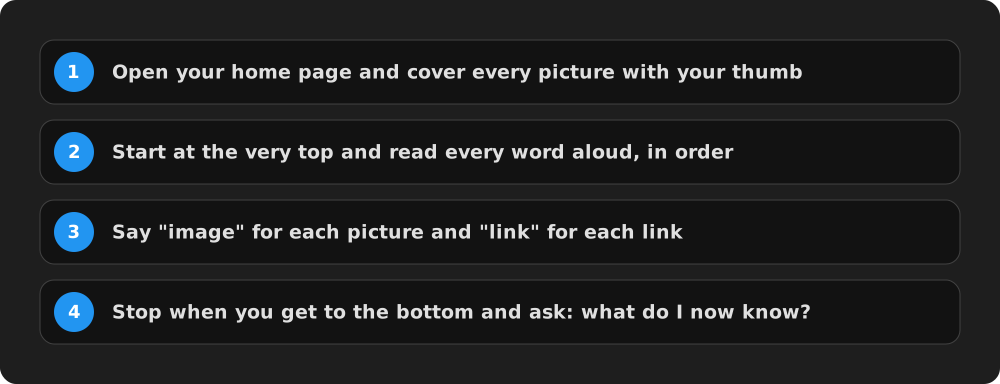
Then ask the questions an agent would be asked. What is this business called? Where is it? What does it do? What does it cost? When is it open? How do I get in touch? If any of those took more than a few seconds to answer from the words alone, or could not be answered at all, that is what an agent cannot tell a customer either.
Most people who try this are surprised. The site they thought was clear turns out to say "Welcome", "image", "image", "We look forward to seeing you", "link", "link". All the meaning was in the pictures and the layout, and none of it was in the words.
The fix is rarely a rebuild. It is usually a better title, a few real headings, the address as text, a sentence of description on each picture, and the menu or price list typed out. We do all of this on the sites we build, and check them with the same test before they go live. But it is worth doing on any site, whoever built it, because the agents are already visiting. The only question is whether they leave knowing what you do.