
Software
Who actually writes it?
AI drafts, a separate review decides
A person decides what is built. Every change is independently reviewed and tested before it ships.
Anyone can ask AI for an app. Making one that is safe, that fits your business and that grows with it takes specialists. We are the AI specialists, for businesses anywhere in the world.
Turn it into a
Every business has a spreadsheet like this one. Press a button to see what replaces it.
| A | B | C | D | E |
|---|---|---|---|---|
| Mrs Okafor | 09:00 | Cut+colour | 65 | paid |
| D. Whitlow | 10:30 | Trim | 18 | ?? |
| same lady | 12:00 | colour | 65 | cash? |
| Priya (resc) | 2pm | Cut | 22 | paid |
| 15:15 | Beard | 12 | unpaid | |
| J Mensah | 16:00 | Cut+beard | 30 | paid |
Today
Tuesday, 6 jobsOutstanding
3 overdueBelow minimum
reorder before FridayBuilt by the same people with the same tools. Most are free, so try one now.
Secure and very fast, and hosted by us.
We build both, on a base already written and tested.
Built around your business today, and changed as your business changes. A fixed quote in writing, with a completion date.
What we buildHosting, contact form and live chat included. No cookies, no consent banner.
What comes with oneAsking AI for an app is the easy part. Knowing what it got wrong is the job.
The repetitive part takes minutes of machine time, not weeks.
Every change goes through 42 separate checks before it ships. Every finding is fixed, even the ones that look minor, because a few minor faults put together can make a serious one.
If we misjudge how long it takes, that is our problem, not yours.
In your own words. No specification needed.
Fixed, with a completion date, in writing.
Log in early and say what is wrong.
The code and the data are yours.
Twenty-five answers in five topics, in plain words.
AI drafts, a separate review decides
A person decides what is built. Every change is independently reviewed and tested before it ships.
Yes, in full
With plain documentation and an export for everything. If we walked away tomorrow, somebody else could pick it up.
Written down, with a completion date
The quote is agreed before work starts. It changes only if you ask for something that was not in your description, and we tell you first.
You take everything
All exportable, and no notice period. For software, the code and data are yours in full.
No, nothing to consent to
There is nothing to consent to. We set no cookies and collect no personal data.
Global, and it makes no difference
Registered in England and Wales, with everything done remotely. Where you are makes no difference to how quickly we answer.
No specification needed, and usually an answer back the same week.
Tell us what you needFor a while the FAQ page had a bad name. It became the place where businesses hid the things they did not want to say plainly, or padded a site with questions nobody had ever asked. Designers stopped including one. Then AI assistants started reading websites to answer people's questions, and the humble FAQ page turned out to be exactly the shape they were looking for.
Here is why, and how to write one that helps both the person reading it and the assistant answering on their behalf.
When someone asks ChatGPT or Gemini "do I need a deposit to book a table for twelve at a restaurant in Ludlow", the assistant goes looking for a page that contains a question like that and an answer straight after it. A question followed by an answer is the easiest thing in the world for it to lift and repeat. It does not have to guess what a paragraph is about, or piece an answer together from three places. The question tells it, and the answer is right there.
The same is true of search engines, which have shown question-and-answer snippets for years. And it is true of people, who mostly arrive at a website with one specific thing they want to know. A page that lists real questions and gives real answers serves all three at once, which is rare.
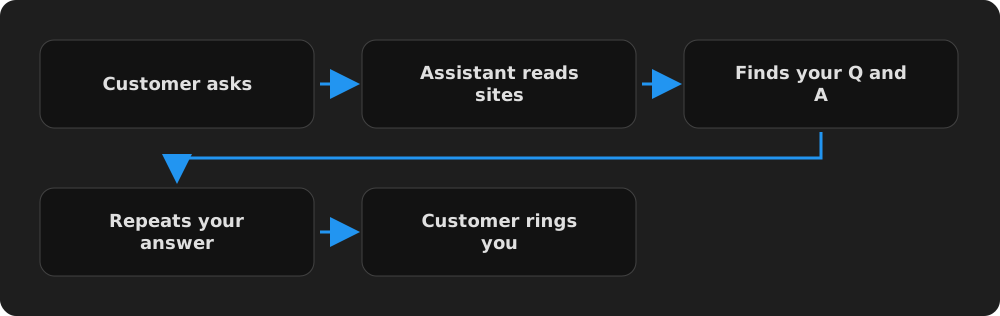
This is the part most FAQ pages get wrong. They are written from the business's side of the counter. "What are your service offerings?" is not a question anyone has ever asked. "Do you do small jobs?" is. The words matter, because the assistant is matching what the customer typed against what is on your page.
Some ways to find the real questions:
Keep the customer's words. "Can I park outside?" not "What are the parking arrangements?". "How much is a cut?" not "What is your pricing structure?". "Will you come out on a Saturday?" not "What are your operating hours?". If it sounds like something said across a counter, it is right.
Each answer should be one or two short paragraphs, and it should actually answer the question. Not "it depends, ring us", unless it genuinely does, in which case say what it depends on. If someone asks about price, give a price or a range. If they ask about cancellations, say what happens if they cancel and when. If the honest answer is not flattering, give it anyway. "We do not do emergency call-outs after nine" saves you a phone call at half past ten and saves the customer a wasted one.
A useful habit is to write the answer as if a friend had asked. You would not say "we pride ourselves on flexible scheduling". You would say "weekday evenings are fine, Sundays are not".
Answer as if a friend had asked, and put the price in.
The questions differ by trade, but in our experience the ones people most want answered before they get in touch are practical. Here is a starting list. Cut what does not apply and add your own.
| Topic | The sort of question | What a good answer contains |
|---|---|---|
| Prices | How much is it? Do you charge for a quote? | A number or a range, and what is not included |
| Parking and finding you | Where do I park? Which door? | Street names, the nearest car park, what the building looks like |
| Deposits | Do I pay anything up front? | How much, when, and whether it comes off the bill |
| Cancellations | What if I need to cancel? | How much notice, and what you charge if less |
| What to bring | Do I need to bring anything? | Documents, measurements, a photo of the problem, the dog on a lead |
| Timing | How long will it take? How soon can you come? | A typical wait and a typical job length |
| Areas | Do you cover my town? | The towns and villages you go to, by name |
| Payment | Can I pay by card? | Card, bank transfer, cash, and when payment is due |
For a café that might be: do you take bookings, is there somewhere to sit outside, are dogs allowed, do you do gluten-free, what time does the kitchen close. For a solicitor: what is the first meeting for, is it free, what do I bring, how long does a will take, how do you charge. For a hairdresser: do I need to book, how far ahead, what if I am late, do you do children, can I bring a picture. You know your own list better than we do.
An FAQ page is only useful whilst it is true. The danger of a page that AI assistants repeat is that they repeat it after it has gone stale. If your price went up in the spring and the page still says the old one, an assistant will quote the old one to a customer, who will then feel misled when the bill arrives. That is worse than having no price at all.
So treat the page as something you look at, not something you wrote once. A short routine keeps it honest:
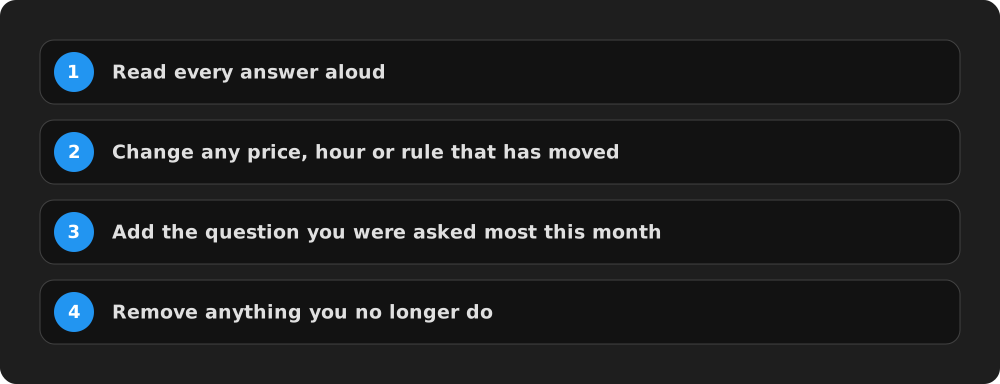
Put a reminder in the diary for the start of each season. Early September is a good one, because hours and prices often shift after the summer, and again in late November before the Christmas trade. If an answer changes mid-season, change it the same day. It takes a minute and it is the difference between a page that helps and a page that quietly causes complaints.
Two smaller points. Keep the questions on the page as ordinary text, not hidden inside a picture or a widget that only opens when clicked, because assistants cannot read those. And do not stuff the page with fifty questions to look thorough; a dozen real ones are worth more than fifty invented ones.
We build an FAQ page into every site we make, with the questions written the way people actually ask them and marked up so assistants can find them. But the questions themselves have to come from you, because you are the one who hears them every day. Start with the five you are most tired of answering on the phone. Those are the five your website should answer first.