
Software
Who actually writes it?
AI drafts, a separate review decides
A person decides what is built. Every change is independently reviewed and tested before it ships.
Anyone can ask AI for an app. Making one that is safe, that fits your business and that grows with it takes specialists. We are the AI specialists, for businesses anywhere in the world.
Turn it into a
Every business has a spreadsheet like this one. Press a button to see what replaces it.
| A | B | C | D | E |
|---|---|---|---|---|
| Mrs Okafor | 09:00 | Cut+colour | 65 | paid |
| D. Whitlow | 10:30 | Trim | 18 | ?? |
| same lady | 12:00 | colour | 65 | cash? |
| Priya (resc) | 2pm | Cut | 22 | paid |
| 15:15 | Beard | 12 | unpaid | |
| J Mensah | 16:00 | Cut+beard | 30 | paid |
Today
Tuesday, 6 jobsOutstanding
3 overdueBelow minimum
reorder before FridayBuilt by the same people with the same tools. Most are free, so try one now.
Secure and very fast, and hosted by us.
We build both, on a base already written and tested.
Built around your business today, and changed as your business changes. A fixed quote in writing, with a completion date.
What we buildHosting, contact form and live chat included. No cookies, no consent banner.
What comes with oneAsking AI for an app is the easy part. Knowing what it got wrong is the job.
The repetitive part takes minutes of machine time, not weeks.
Every change goes through 42 separate checks before it ships. Every finding is fixed, even the ones that look minor, because a few minor faults put together can make a serious one.
If we misjudge how long it takes, that is our problem, not yours.
In your own words. No specification needed.
Fixed, with a completion date, in writing.
Log in early and say what is wrong.
The code and the data are yours.
Twenty-five answers in five topics, in plain words.
AI drafts, a separate review decides
A person decides what is built. Every change is independently reviewed and tested before it ships.
Yes, in full
With plain documentation and an export for everything. If we walked away tomorrow, somebody else could pick it up.
Written down, with a completion date
The quote is agreed before work starts. It changes only if you ask for something that was not in your description, and we tell you first.
You take everything
All exportable, and no notice period. For software, the code and data are yours in full.
No, nothing to consent to
There is nothing to consent to. We set no cookies and collect no personal data.
Global, and it makes no difference
Registered in England and Wales, with everything done remotely. Where you are makes no difference to how quickly we answer.
No specification needed, and usually an answer back the same week.
Tell us what you needAsk most small business owners when the year really starts and they will not say the first of January. They will say September. The schools go back, the holidays are over, and everybody who spent August half switched off comes back to their desk, their diary and their phone. In our experience the enquiries pick up within a week or two of the new term, and they pick up for almost every kind of business, not just the ones with a school run in their customer base.
That makes September a second January. People make plans. They finally book the plumber they meant to ring in June. They look for a new hairdresser because the old one moved. They sort out the accountant before the tax return deadline creeps up. Households look at budgets after the summer spend, and so do firms, who often set their autumn and Christmas spending in the first fortnight of the month. Whatever they decide, most of them start by searching, and more and more of them start by asking an assistant on their phone rather than typing into Google.
Your website is what they find. If it looks like nobody has touched it since spring, that is the impression they take away. The good news is that it does not take a big project to fix. Two weeks of small, unglamorous jobs will do it. Here is the plan we use with our own clients.
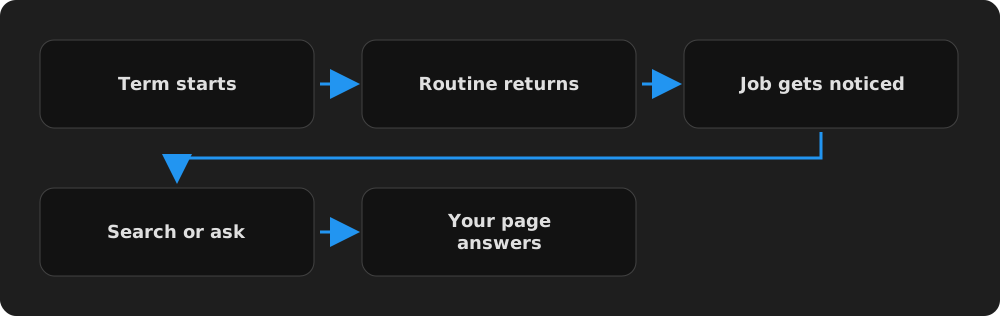
Routines are what drive searches. When the days have a shape again, people notice the things that are broken or missing. The boiler that grumbled in April is suddenly urgent. The garden fence that leaned all summer will not last another winter. The shop window that looked fine in July looks tired in the September light. Each of those thoughts turns into a search, and each search is a chance for a well-kept website to be the answer.
There is a second effect. AI assistants such as ChatGPT, Gemini and Apple's assistant read websites to answer questions, and they prefer pages that are current, plain and specific. A site with last year's prices, a Christmas notice still showing in August, or a phone number that rings out gets quietly passed over in favour of one that is clearly looked after. Freshness is not a trick; it is simply evidence that a real business is behind the page.
The first week is about honesty. Everything on the site should be true today. Read every page as if you were a stranger and note anything out of date. Then fix it.
Tidying also means removing. Most sites we take on have at least one page nobody needs: a gallery of four blurry photos, a 'coming soon' that has been coming for three years, a testimonials page with two quotes. Fewer, better pages are easier for a visitor to read and easier for a search engine or an assistant to understand. If a page does not help someone decide to contact you, ask whether it needs to exist.
With the housekeeping done, add one thing. Just one. The temptation in September is to plan a whole redesign, and that plan usually dies by October. A single new page, written plainly, is worth more than a redesign that never ships.
Pick the page by asking what people ring you about most. If the answer is a service that does not have its own page, write that page. If the answer is a question, such as whether you do weekend appointments or how long a job takes, write a page that answers it in the first sentence and explains in the rest. A page like that is exactly what an assistant looks for when somebody asks the same question out loud.
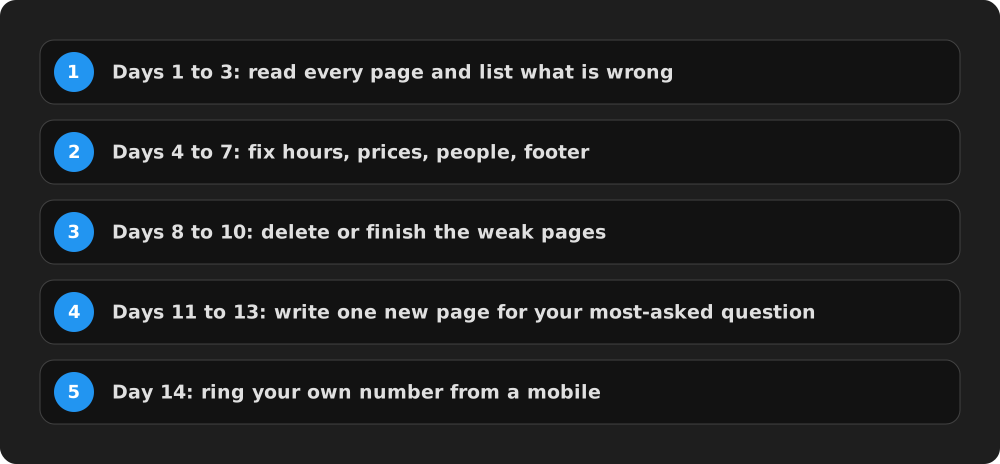
Then the phone call. On the last day, take out your mobile and ring the number on your website. Not the one in your head, the one on the page. Tap it on the site rather than typing it. Does it ring the right phone? Does the voicemail sound like a business? Does the email address on the contact page still go to a mailbox someone reads? We have seen more than one firm lose a month of autumn enquiries to a number that was one digit out or a form that quietly sent to an old address. Five minutes of checking is worth more than any amount of design.
A redesign that never ships is worth less than one true page that does.
It is just as important to know what not to do. Do not change your business name, your page addresses or your main headings on a whim; search engines and assistants have learnt them, and changing them for no reason resets that. Do not add a pop-up, a chat bubble you will not answer, or a newsletter box you will never send to. Do not put your hours or prices into an image because it looks smarter; nobody, human or machine, can read them there. And do not add anything that tracks visitors. A small business does not need it, and the people you want as customers increasingly notice and dislike it.
If you keep a site with us, most of the week one list is already done for you, and we will happily write the week two page with you. Either way, the plan works with any website and any builder. Give September the same fresh start you would give January, and it will pay you back well before the Christmas trade arrives.