Software
Who actually writes it?
AI drafts, a separate review decides
A person decides what is built. Every change is independently reviewed and tested before it ships.
Anyone can ask AI for an app. Making one that is safe, that fits your business and that grows with it takes specialists. We are the AI specialists, for businesses anywhere in the world.
Turn it into a
Every business has a spreadsheet like this one. Press a button to see what replaces it.
| A | B | C | D | E |
|---|---|---|---|---|
| Mrs Okafor | 09:00 | Cut+colour | 65 | paid |
| D. Whitlow | 10:30 | Trim | 18 | ?? |
| same lady | 12:00 | colour | 65 | cash? |
| Priya (resc) | 2pm | Cut | 22 | paid |
| 15:15 | Beard | 12 | unpaid | |
| J Mensah | 16:00 | Cut+beard | 30 | paid |
Today
Tuesday, 6 jobsOutstanding
3 overdueBelow minimum
reorder before FridayBuilt by the same people with the same tools. Most are free, so try one now.
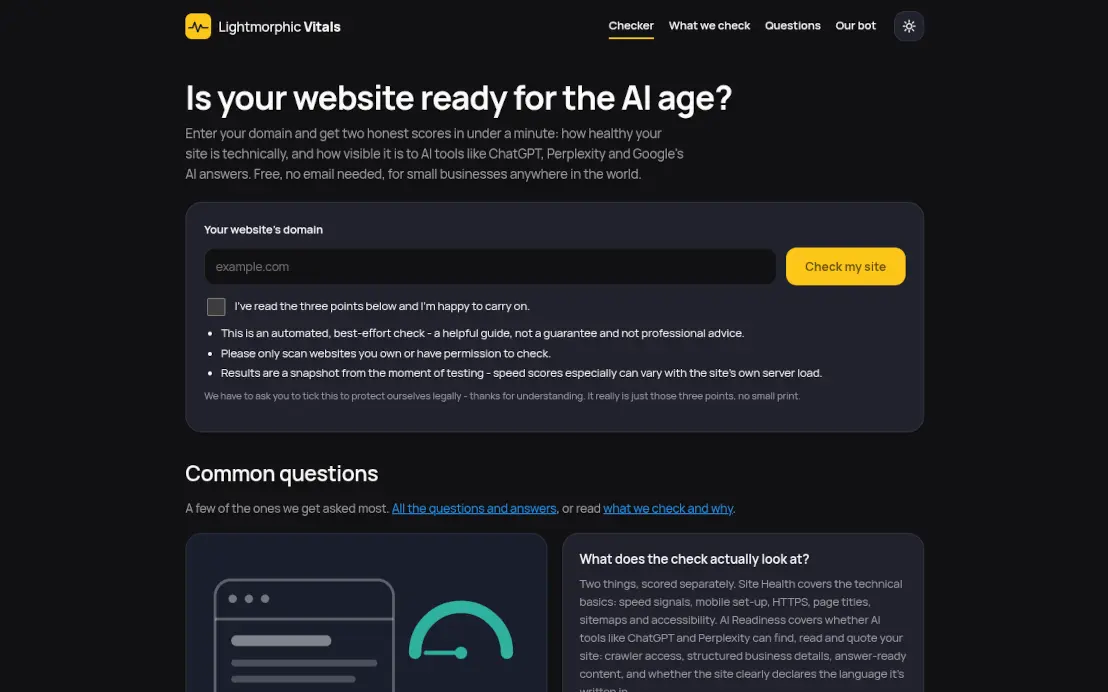 Lightmorphic VitalsFree website health and AI check.
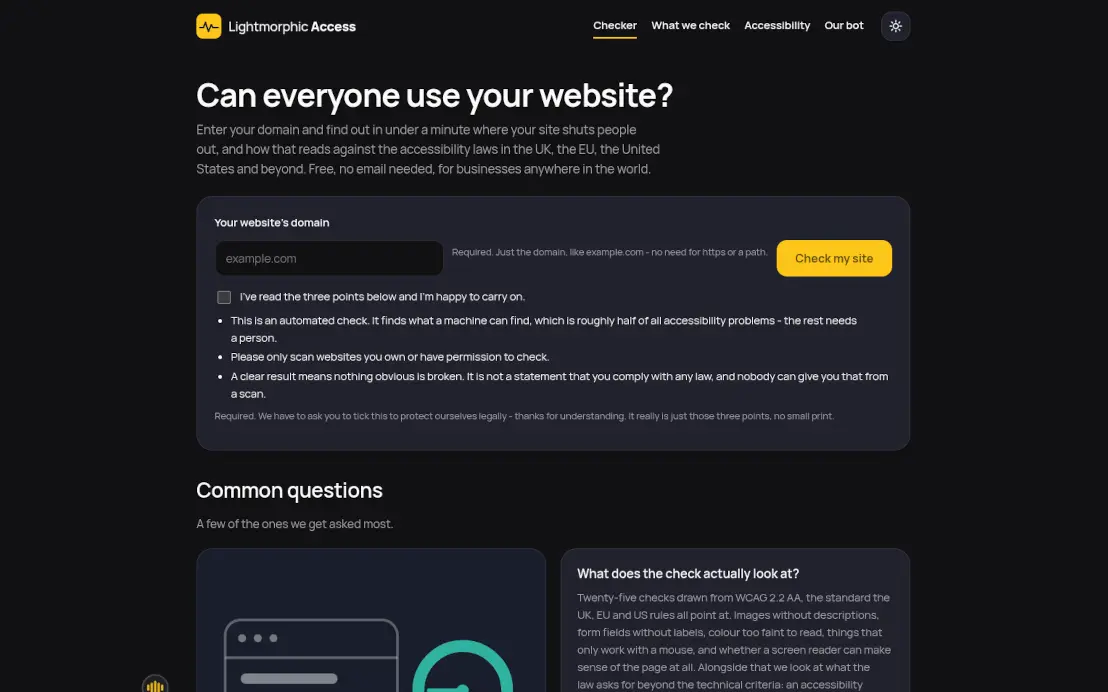 Lightmorphic AccessFree accessibility checker.
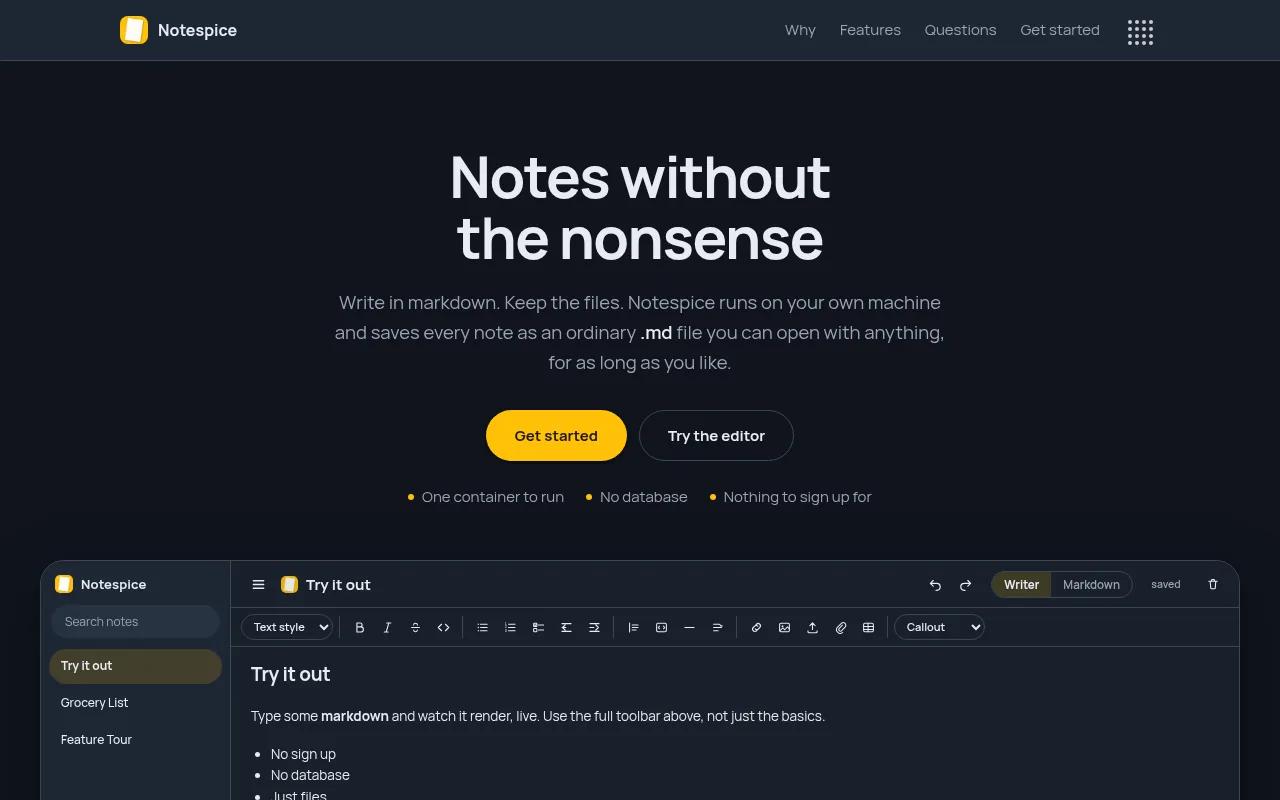 NotespiceSelf-hosted notes as plain files.
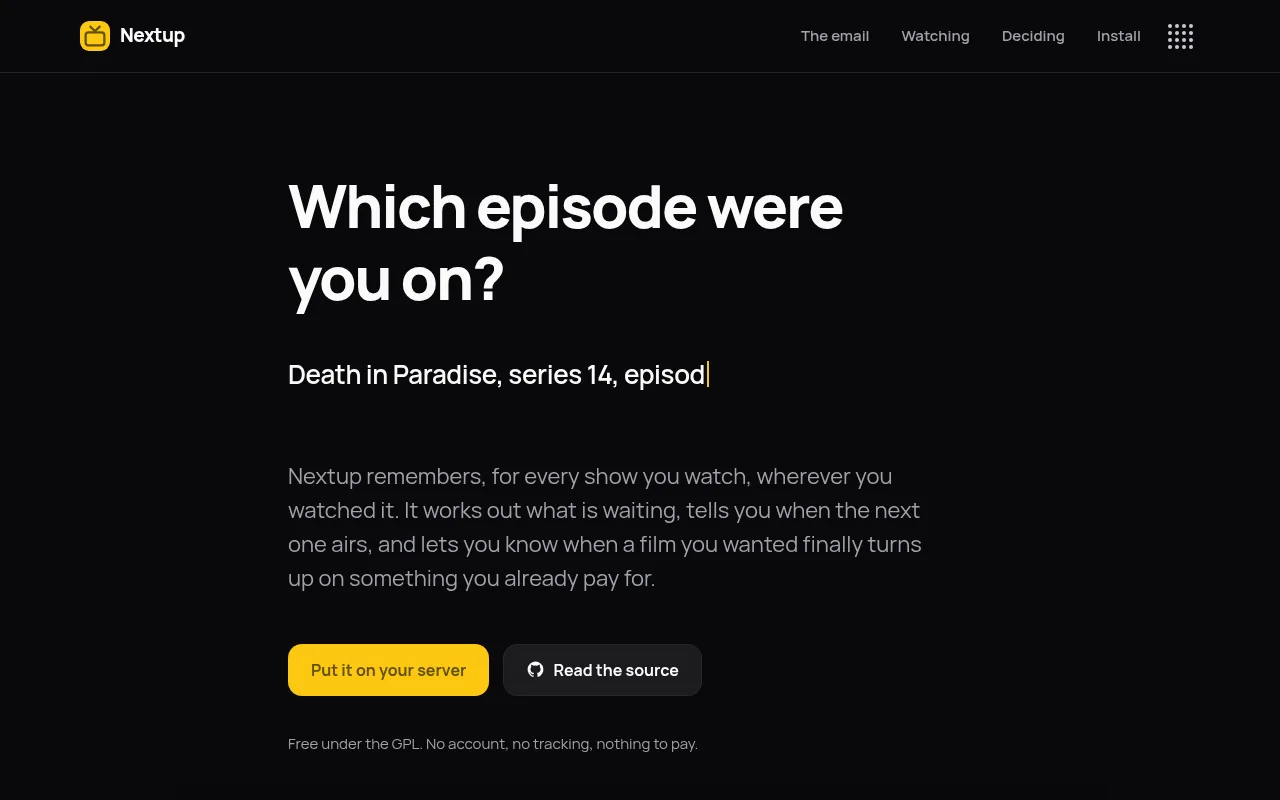 NextupRemembers which episode you are on.
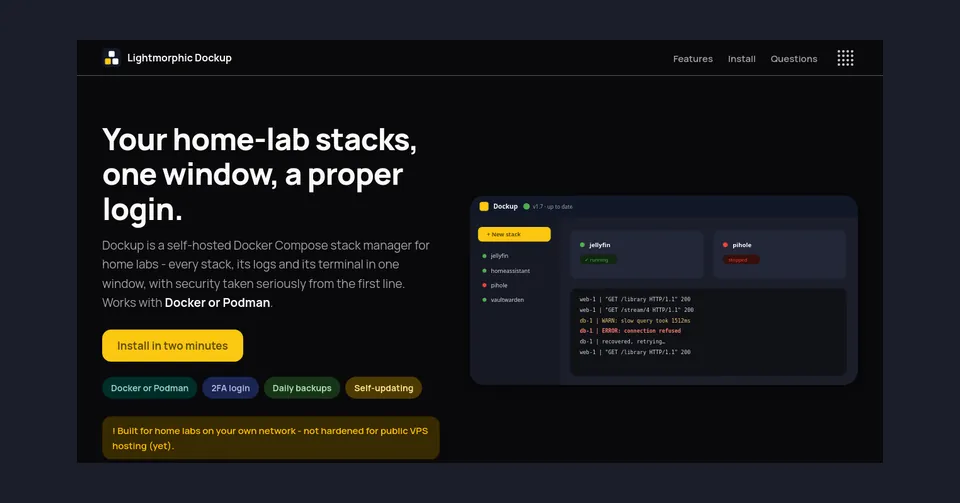 Lightmorphic DockupDocker Compose manager for home labs.
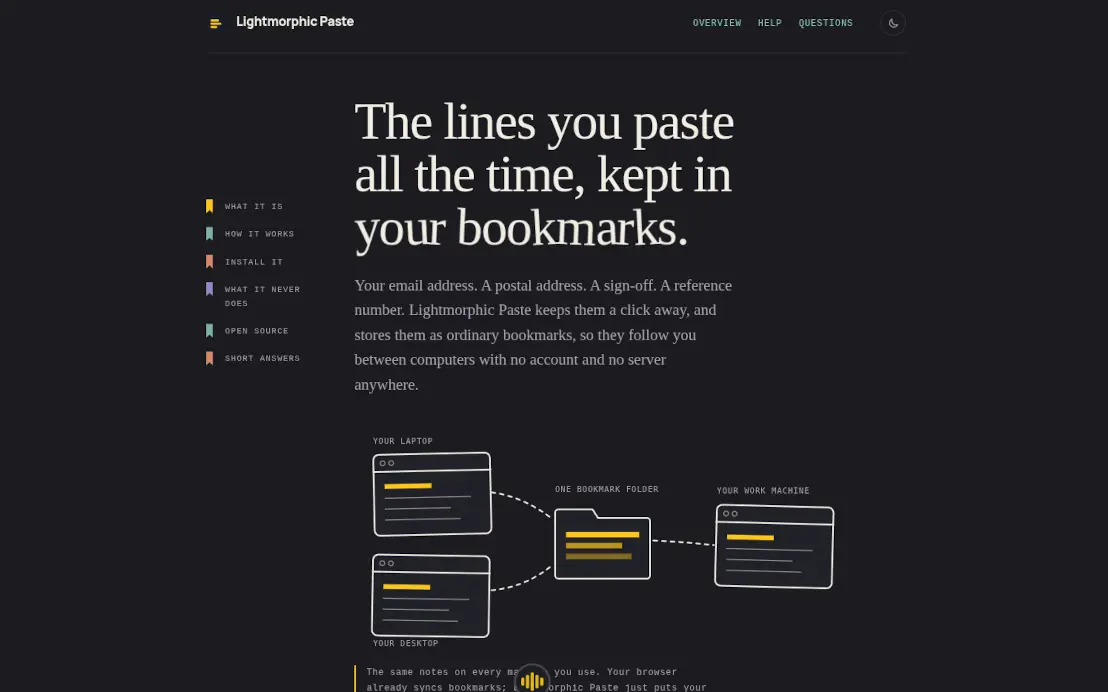 Lightmorphic PasteBrowser extension for lines you paste often.
Secure and very fast, and hosted by us.
We build both, on a base already written and tested.
Built around your business today, and changed as your business changes. A fixed quote in writing, with a completion date.
What we buildHosting, contact form and live chat included. Your site needs no cookie banner, because it sets no cookies.
What comes with oneAsking AI for an app is the easy part. Knowing what it got wrong is the job.
The repetitive part takes minutes of machine time, not weeks.
Every change goes through 42 separate checks before it ships. Every finding is fixed, even the ones that look minor, because a few minor faults put together can make a serious one.
If we misjudge how long it takes, that is our problem, not yours.
In your own words. No specification needed.
Fixed, with a completion date, in writing.
Log in early and say what is wrong.
Online software, ready to use. Your data stays yours.
Twenty-five answers in five topics, in plain words.
AI drafts, a separate review decides
A person decides what is built. Every change is independently reviewed and tested before it ships.
Yes, in full
We do not hand it over and say goodbye. We keep it running, safe and secure, with updates and fixes, as part of an annual maintenance subscription. Your data is always yours.
Written down, with a completion date
The quote is agreed before work starts. It changes only if you ask for something that was not in your description, and we tell you first.
You take your data
All exportable, and no notice period.
11,000+ in one year
New WordPress vulnerabilities were catalogued in a single year, which is why it needs constant updating. Our sites are built to be secure and very fast, without that upkeep.
Global, and it makes no difference
Registered in England and Wales, with everything done remotely. Where you are makes no difference to how quickly we answer.
No specification needed, and usually an answer back the same week.
Tell us what you needFor twenty years the deal was simple. Somebody typed a question into Google, Google gave them ten links, and they picked one. If your website was on that first page, you got the visit. If it was on page two, you did not. Every bit of advice about websites for small businesses grew out of that deal.
That deal is changing. More and more, people ask a question and get an answer, not a list. They ask their phone. They ask a chat window. They ask the assistant built into their car or their kitchen speaker. The answer comes back as a sentence or two, sometimes spoken aloud, and it names one or two businesses. Nobody sees the other eight.

The tools people use to find things now read pages and write a summary rather than just ranking them. ChatGPT, Gemini, Apple's assistant and the AI panels at the top of ordinary search results all work this way. Someone asks "who can fix a leaking tap in Ely today" and the assistant looks at the pages it knows about, works out which ones answer that question, and replies with a name, a phone number and perhaps a price.
This matters for a small business more than for a big one. A big brand gets named because everybody already knows it. A small firm gets named only if the assistant can find, on your own page, a clear answer to the question that was asked. If your page is vague, the assistant moves on to one that is not.
It also changes what a visit means. Fewer people will browse your site for five minutes. More of them will arrive already knowing what you do and what it costs, because the assistant told them. The job of the website is shifting from persuading a visitor to being the source an assistant trusts.
Assistants are not magic. They are readers, and rather literal ones. When one lands on your page it is trying to fill in a small set of blanks: who is this, what do they do, where, for how much, when, and how do I get in touch. If those facts are written down plainly, it can use them. If they are hidden in a picture, buried in a slogan or missing altogether, it cannot.
None of this is new. Good websites have always done it. The difference is that the cost of not doing it has gone up. Before, a vague page might still rank and a human would work it out by reading around. Now the vague page simply does not get mentioned, and the owner never finds out why.
It helps to think about how a real person phrases a question to an assistant. They do not type keywords. They ask the way they would ask a neighbour. "Is there a dog groomer near me that does big dogs?" "How much does a will cost from a solicitor in Kent?" "Which café in town has somewhere to park a pram?"
Notice that each question has a detail in it: big dogs, Kent, pram. The assistant is looking for a page that mentions that detail. If your grooming page says you take all sizes up to a Great Dane, you are in the running. If it just says "professional grooming for your beloved pet", you are not, even though you might be the better groomer.
A useful exercise is to write down the ten questions your customers ask you most often on the phone, then check whether each one is answered somewhere on your site in a sentence a stranger could quote. In our experience most small firms find that about half are answered, and the other half live only in the owner's head.
If the answer is only in your head, no assistant can pass it on.
It does not mean rewriting your site to sound like a robot, or stuffing it with the phrase "near me". Assistants are quite good at spotting that, and so are people. It does not mean paying anybody for a listing, either. The assistants read the open web; there is no special queue to join.
It also does not mean ordinary search is dead. Plenty of people still scroll a list of results, and the same clear, factual page does well there too. The work is the same work. What has changed is that it now pays twice.
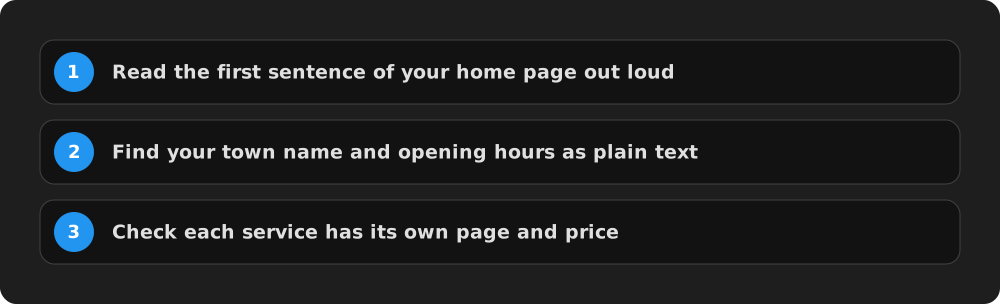
Start with the home page. Read the first sentence aloud and ask whether a stranger would know what you do and where. Then look for your town, your hours and your phone number as ordinary text. Then look at your services: does each one have its own page, and does that page say what it costs?
Those three checks take a quarter of an hour and will tell you most of what you need to know. We build every Sitemorphic site with this in mind from the first page, but the checks work just as well on a site somebody else built years ago. The aim is the same either way: when somebody asks the question, your page is the one that answers it.