Software
Who actually writes it?
AI drafts, a separate review decides
A person decides what is built. Every change is independently reviewed and tested before it ships.
Anyone can ask AI for an app. Making one that is safe, that fits your business and that grows with it takes specialists. We are the AI specialists, for businesses anywhere in the world.
Turn it into a
Every business has a spreadsheet like this one. Press a button to see what replaces it.
| A | B | C | D | E |
|---|---|---|---|---|
| Mrs Okafor | 09:00 | Cut+colour | 65 | paid |
| D. Whitlow | 10:30 | Trim | 18 | ?? |
| same lady | 12:00 | colour | 65 | cash? |
| Priya (resc) | 2pm | Cut | 22 | paid |
| 15:15 | Beard | 12 | unpaid | |
| J Mensah | 16:00 | Cut+beard | 30 | paid |
Today
Tuesday, 6 jobsOutstanding
3 overdueBelow minimum
reorder before FridayBuilt by the same people with the same tools. Most are free, so try one now.
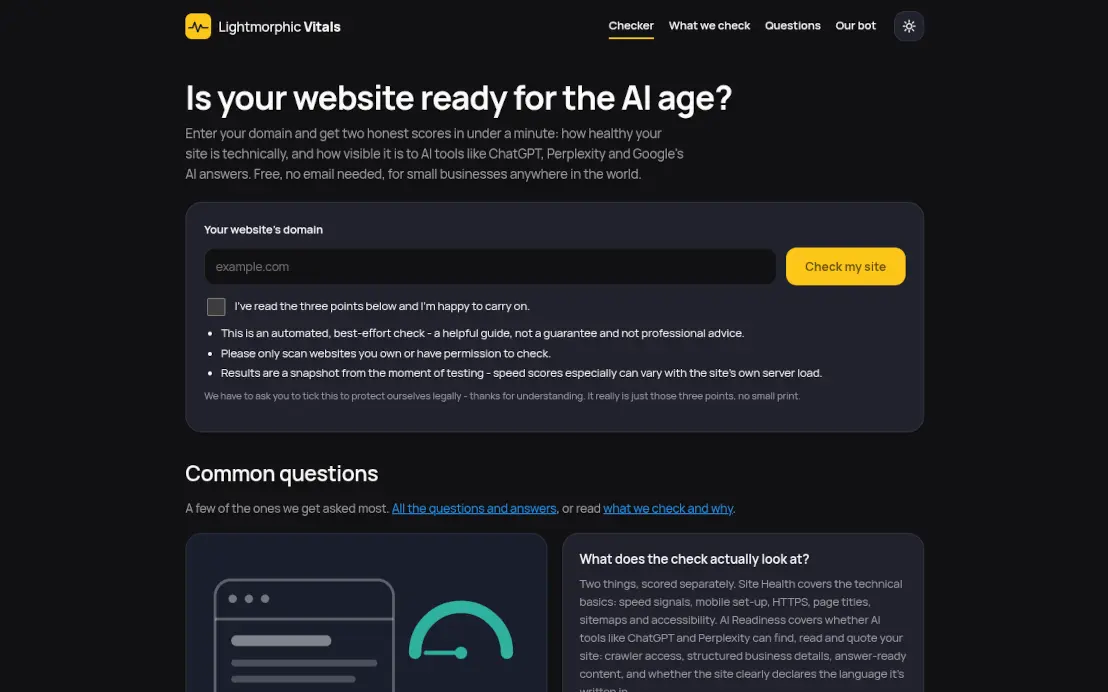 Lightmorphic VitalsFree website health and AI check.
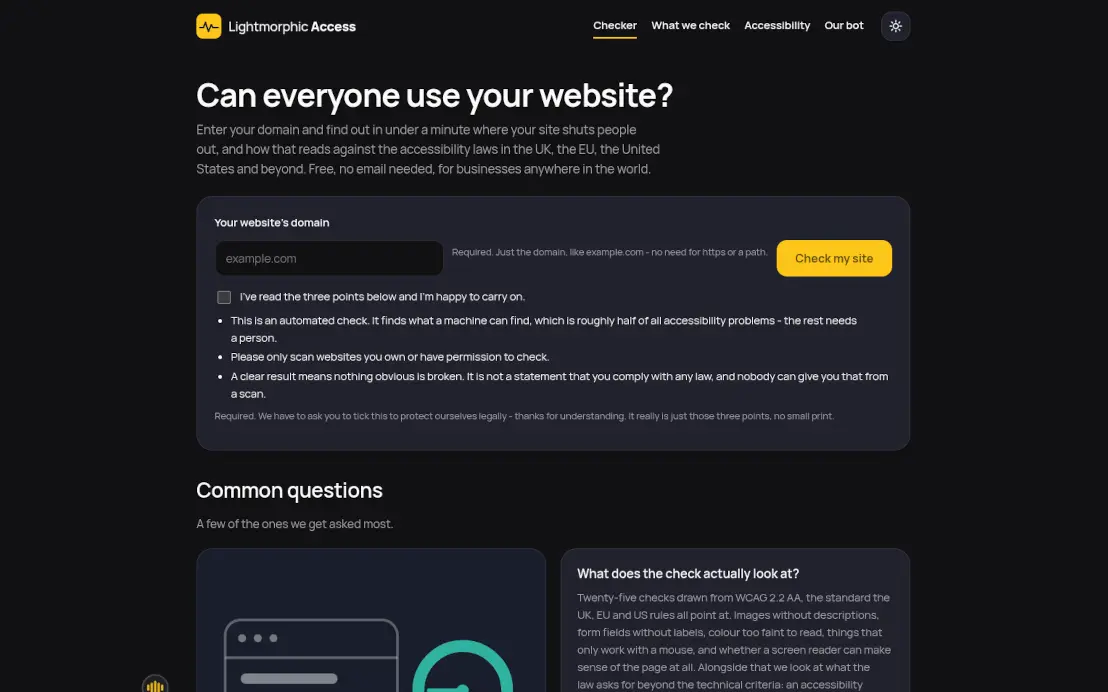 Lightmorphic AccessFree accessibility checker.
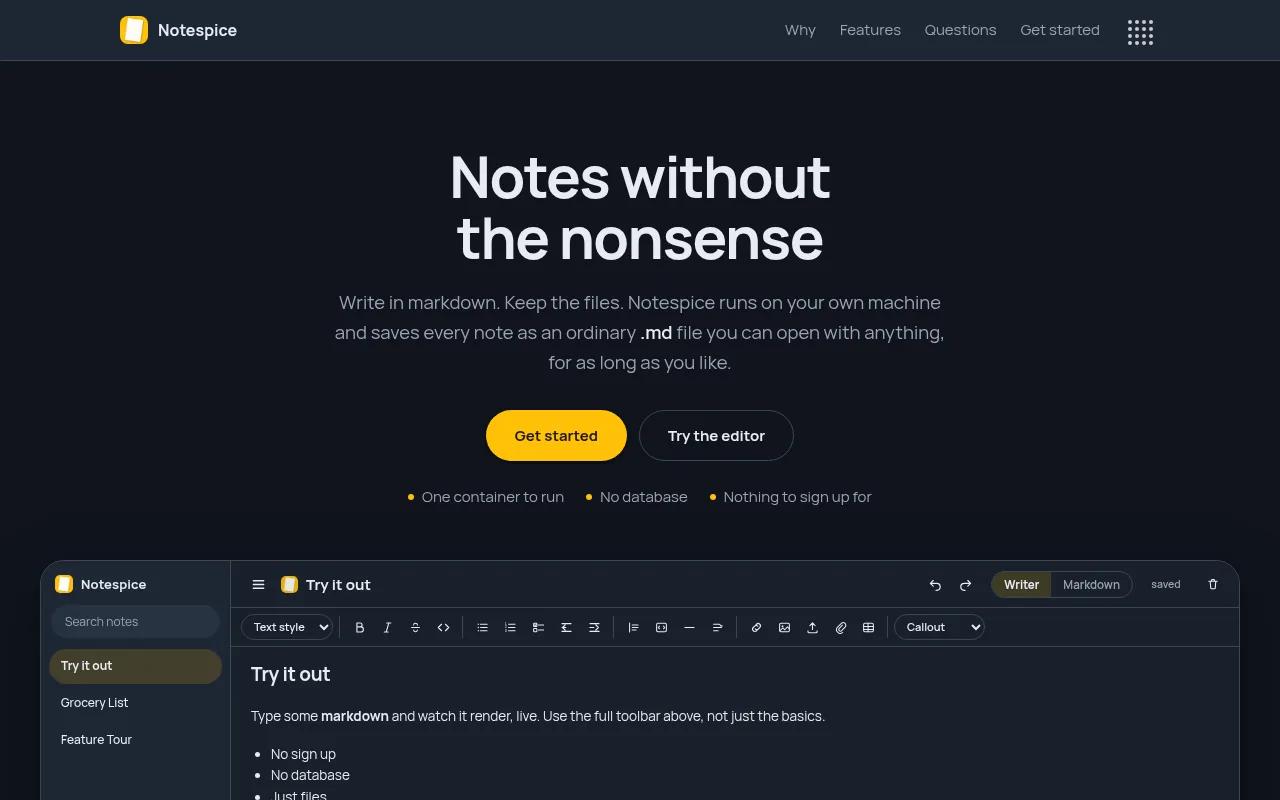 NotespiceSelf-hosted notes as plain files.
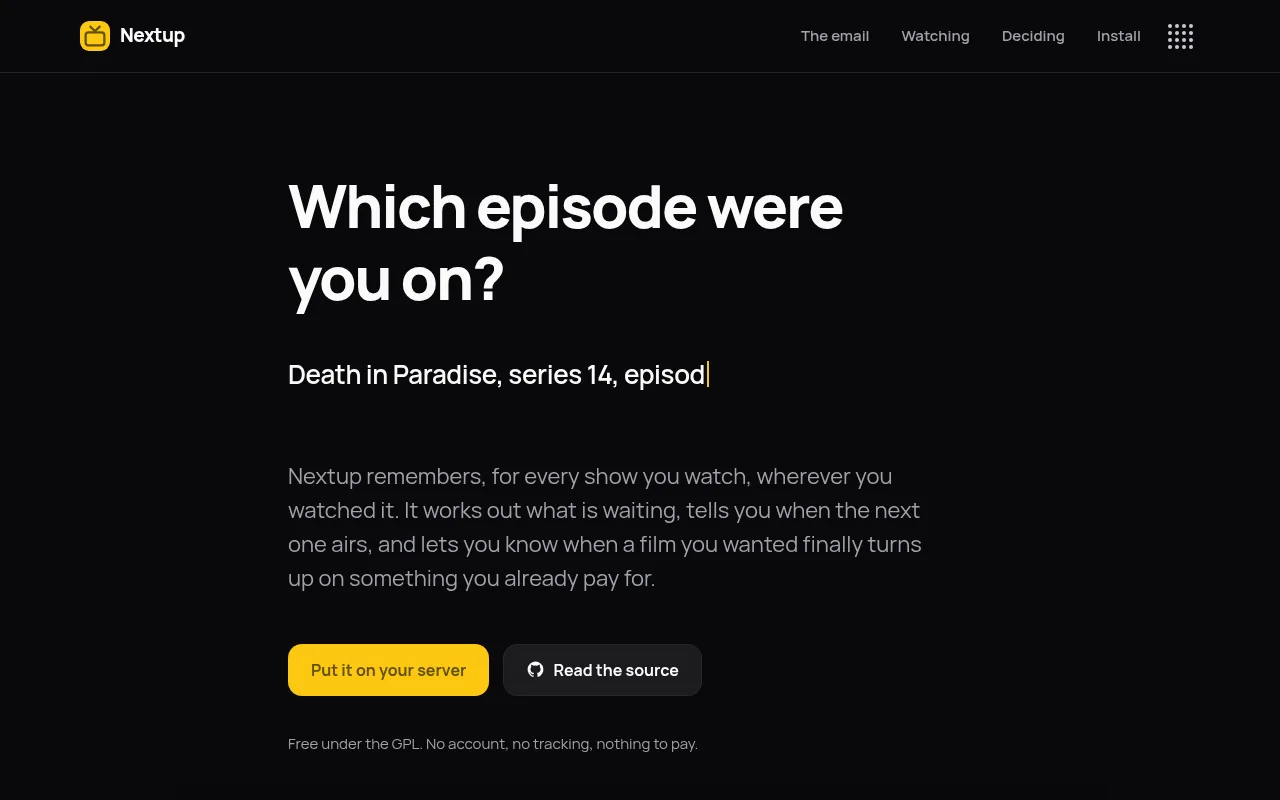 NextupRemembers which episode you are on.
 Lightmorphic DockupDocker Compose manager for home labs.
 Lightmorphic PasteBrowser extension for lines you paste often.
Secure and very fast, and hosted by us.
We build both, on a base already written and tested.
Built around your business today, and changed as your business changes. A fixed quote in writing, with a completion date.
What we buildHosting, contact form and live chat included. Your site needs no cookie banner, because it sets no cookies.
What comes with oneAsking AI for an app is the easy part. Knowing what it got wrong is the job.
The repetitive part takes minutes of machine time, not weeks.
Every change goes through 42 separate checks before it ships. Every finding is fixed, even the ones that look minor, because a few minor faults put together can make a serious one.
If we misjudge how long it takes, that is our problem, not yours.
In your own words. No specification needed.
Fixed, with a completion date, in writing.
Log in early and say what is wrong.
Online software, ready to use. Your data stays yours.
Twenty-five answers in five topics, in plain words.
AI drafts, a separate review decides
A person decides what is built. Every change is independently reviewed and tested before it ships.
Yes, in full
We do not hand it over and say goodbye. We keep it running, safe and secure, with updates and fixes, as part of an annual maintenance subscription. Your data is always yours.
Written down, with a completion date
The quote is agreed before work starts. It changes only if you ask for something that was not in your description, and we tell you first.
You take your data
All exportable, and no notice period.
11,000+ in one year
New WordPress vulnerabilities were catalogued in a single year, which is why it needs constant updating. Our sites are built to be secure and very fast, without that upkeep.
Global, and it makes no difference
Registered in England and Wales, with everything done remotely. Where you are makes no difference to how quickly we answer.
No specification needed, and usually an answer back the same week.
Tell us what you needImagine your shop with no signs on anything. No label on the door saying when you open, no price on the shelf, no name over the window. A person could still work most of it out by looking around and asking. A machine could not. That is roughly the situation a website is in when it has no structured data.
Structured data, which most people call schema or schema markup, is a set of hidden labels on a web page. The visitor never sees them. Google, Bing, and the AI assistants like ChatGPT, Gemini and Apple's AI all read them, and they read them first, because a label is faster and safer to trust than guessing from the wording of a paragraph. This post is about what those labels are, which ones matter for a small business, and the one rule you must never break.
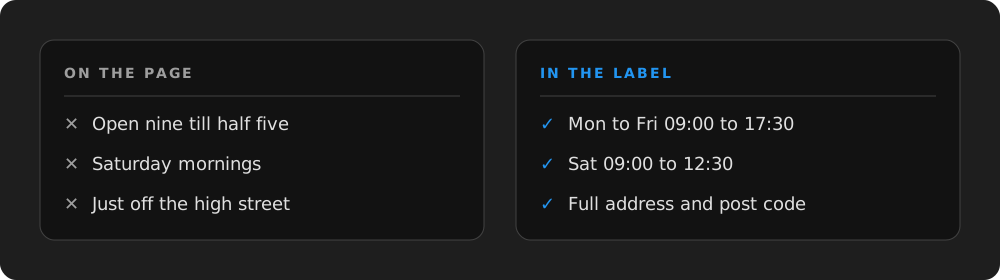
Say your contact page says, in ordinary writing, "We're open Monday to Friday, nine till half five, and Saturday mornings." A person reads that instantly. A machine has to work out that "half five" means 17:30, that "Saturday mornings" means some hours it does not know, and that Sunday is probably closed. It will have a go, and it will sometimes get it wrong.
With schema, the same page carries a label behind the scenes that says, in a format every machine agrees on: business type, name, street address, post code, phone number, and opening hours as exact times for each day of the week. No guessing. When somebody asks their phone "is the bakery on the high street open now?", the assistant can answer with confidence instead of hedging or, worse, answering from an out-of-date directory listing.
There are hundreds of schema types, covering everything from recipes to film screenings. For a small business site, two do almost all of the work.
LocalBusiness. This is the label that says who you are and where you are. It carries your name, address, phone, opening hours, the area you serve, your price range, and a link to your logo. There are more specific versions for common trades, so a café can label itself as a café, a hairdresser as a hair salon, a solicitor as a legal service, and a plumber as a plumber. Using the specific one helps, because it tells the machine exactly what kind of question you are the answer to.
FAQ. This labels a list of questions and answers on the page. Do you do free quotes? Is there parking? Do I need an appointment? Can you deliver on a Saturday? When an AI assistant is asked one of those questions, an FAQ label is the closest thing to handing it the answer on a plate. It also happens to be what people actually want to know before they ring you, so the visible list is useful on its own.
Beyond those two, the ones worth adding when they apply are:
Here is where people get into trouble. Because the labels are hidden, there is a temptation to put things in them that are not on the visible page. Extra services you do not really offer. Five-star reviews that are not shown anywhere. Opening hours that are longer than the real ones because it might bring in a few more calls. An FAQ label on a page that has no questions on it.
Google treats that as a form of cheating and can stop showing your rich results altogether, or worse. The AI assistants are more direct about it: they cross-check the label against the visible text and against other sources, and when the label disagrees with what they can see, they trust the label less. You end up worse off than if you had no labels at all.
A label is a promise about what is on the page. Keep it, and machines start believing you.
So the rule is simple. Everything in the label must be visible on the page, and everything on the page that the label describes must be accurate. If your hours change, change both. If you stop offering a service, remove it from both. If you would be embarrassed to have a customer see the label next to the page, do not ship it.
You may already have some schema and not know it. Most page builders add a little, and a decent web designer will have added the basics. Google gives away a Rich Results Test: you paste in a page address and it tells you what labels it found and whether any of them have errors. There is also a general Schema Markup Validator that does the same job for the wider set of types.
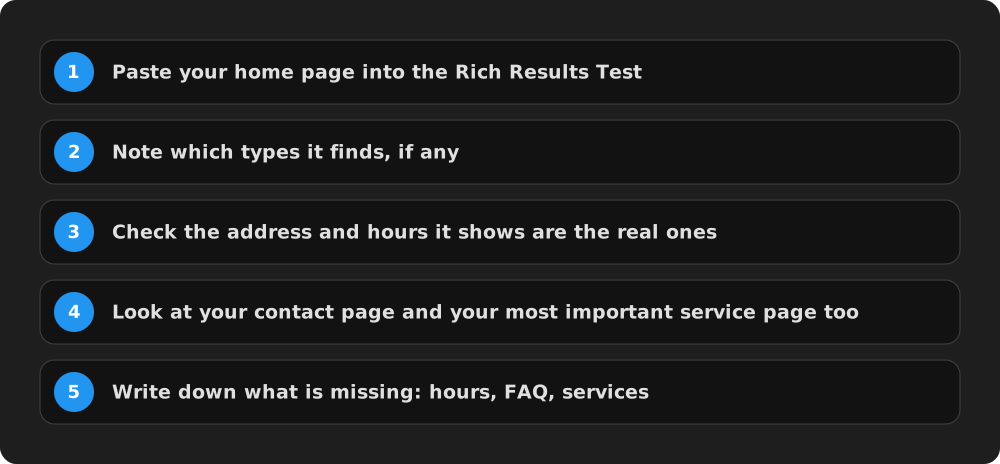
When you run it, you are looking for three things. First, is there a LocalBusiness label at all? Second, does it show the correct name, address, post code and phone number, exactly as they appear on Google Maps and on the page? Third, are the opening hours in there, and are they right? If the answer to any of those is no, that is the job list.
If you look after your own site, most builders have a place to put business details that feeds the LocalBusiness label, and there are free tools that will generate an FAQ label from a list of questions you type in. It is fiddly but not difficult, and the validator will tell you if you have got it wrong.
If somebody builds and looks after your site for you, it should simply be part of the job. We add LocalBusiness, Organisation, Service and FAQ labels to every site we build, and we keep them tied to the visible text so they cannot drift apart. That is what makes a site readable by an AI assistant rather than merely visible to one.
It is early August, and a lot of the questions people will ask their phones in September, when the holidays end and everybody is looking for a plumber, a tutor or somewhere to get their hair done before the wedding, are being decided now by which sites have their labels straight. It is a small job. It is worth doing before the rush.