Software
Who actually writes it?
AI drafts, a separate review decides
A person decides what is built. Every change is independently reviewed and tested before it ships.
Anyone can ask AI for an app. Making one that is safe, that fits your business and that grows with it takes specialists. We are the AI specialists, for businesses anywhere in the world.
Turn it into a
Every business has a spreadsheet like this one. Press a button to see what replaces it.
| A | B | C | D | E |
|---|---|---|---|---|
| Mrs Okafor | 09:00 | Cut+colour | 65 | paid |
| D. Whitlow | 10:30 | Trim | 18 | ?? |
| same lady | 12:00 | colour | 65 | cash? |
| Priya (resc) | 2pm | Cut | 22 | paid |
| 15:15 | Beard | 12 | unpaid | |
| J Mensah | 16:00 | Cut+beard | 30 | paid |
Today
Tuesday, 6 jobsOutstanding
3 overdueBelow minimum
reorder before FridayBuilt by the same people with the same tools. Most are free, so try one now.
Secure and very fast, and hosted by us.
We build both, on a base already written and tested.
Built around your business today, and changed as your business changes. A fixed quote in writing, with a completion date.
What we buildHosting, contact form and live chat included. No cookies, no consent banner.
What comes with oneAsking AI for an app is the easy part. Knowing what it got wrong is the job.
The repetitive part takes minutes of machine time, not weeks.
Every change goes through 42 separate checks before it ships. Every finding is fixed, even the ones that look minor, because a few minor faults put together can make a serious one.
If we misjudge how long it takes, that is our problem, not yours.
In your own words. No specification needed.
Fixed, with a completion date, in writing.
Log in early and say what is wrong.
The code and the data are yours.
Twenty-five answers in five topics, in plain words.
AI drafts, a separate review decides
A person decides what is built. Every change is independently reviewed and tested before it ships.
Yes, in full
With plain documentation and an export for everything. If we walked away tomorrow, somebody else could pick it up.
Written down, with a completion date
The quote is agreed before work starts. It changes only if you ask for something that was not in your description, and we tell you first.
You take everything
All exportable, and no notice period. For software, the code and data are yours in full.
No, nothing to consent to
There is nothing to consent to. We set no cookies and collect no personal data.
Global, and it makes no difference
Registered in England and Wales, with everything done remotely. Where you are makes no difference to how quickly we answer.
No specification needed, and usually an answer back the same week.
Tell us what you needThere is a kind of website that has been fashionable for a few years now. You land on a big photo with a slogan, and then you scroll. And scroll. Services, about us, a few reviews, a map, a form, all on one long page. It looks slick on a designer's screen. It also hides nearly everything a visitor came to find.
We build both kinds, and we are not against a single page for the right business. But most small firms we talk to would be better served by a handful of plain, separate pages, one for each thing they do. This post explains why, how to decide, and how many pages a typical small business actually needs. The short answer is: fewer than you fear, and more than one.
A visitor arrives with one question. Do you fix combi boilers? Can I book a cut and colour on a Saturday? Do you handle probate? On a single long page, the answer is somewhere in the middle, under a heading they have to scroll past a video and three photos to reach. On a phone, that can be twenty screens of thumbing. Many people give up before they get there, and go back to the search results to try the next name.
Machines have the same trouble, only worse. Google gives each page one title and one address, and it tries to work out what that page is about. A page that is about eight things is about nothing in particular, so it ranks poorly for all eight. AI assistants have to summarise the page to answer somebody's question, and a page that mixes boiler repair with bathroom fitting and 'meet the team' gives them a muddle to summarise. When they can, they will pick a competitor whose boiler page is only about boilers.
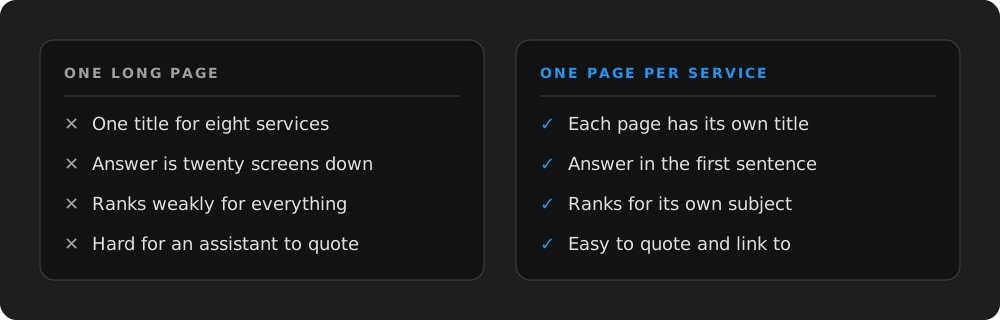
When each service has its own page, three good things happen at once. The visitor lands on the page that matches what they searched for, reads the first line, and knows they are in the right place. Google sees a page with a clear title, a clear heading and a clear subject, and treats it as a serious answer for that subject. And an assistant can read it, quote it, and send the person straight to it, with your phone number in the same breath.
There is a practical bonus too. Separate pages are easier to keep true. When you change the price of a service, you edit one page. When you stop offering something, you delete one page, and the rest of the site is untouched. On a single long page, every edit risks nudging something else out of line.
A page per question works the same way. If people keep ringing to ask whether you charge a call-out fee, a page called 'Do you charge a call-out fee?' that answers it in the first sentence will do more for you than any amount of general text. That is the whole idea behind answer engine optimisation, and it is nothing more exotic than writing down the answers you already give on the phone.
A single page is fine when there is genuinely only one thing to say. A pop-up restaurant with a menu, a date and a booking link. A freelance photographer who does one style of work. A campaign or an event. If a visitor's every likely question can be answered in a few short screens, keep it to one page and keep it short.
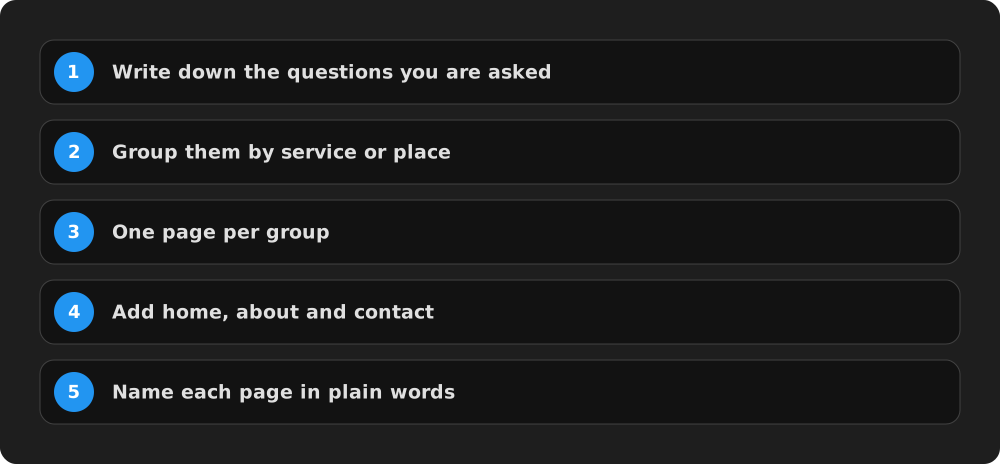
For everyone else, use this test. Write down the questions people actually ask you in a normal week. Then group them. Each group that is about a different service, a different place or a different kind of customer is a page. If the list has more than two or three groups, you need more than one page.
Fewer than you might think. A hairdresser might need home, a page for cuts and colour, a page for treatments, prices, the team, and contact. Six pages. A plumber might need home, boiler repair, boiler installation, bathrooms, emergencies, areas covered, and contact. Seven. A small law firm might have home, then a page for each area of work it wants more of, then about, fees and contact. Perhaps eight to ten.
| Business | Typical page count | Pages that earn their keep |
|---|---|---|
| Café | 4 to 5 | Home, menu, find us, hire the room |
| Trade (plumber, electrician) | 6 to 8 | One per main job type, plus areas covered |
| Hairdresser | 5 to 6 | Services, prices, team, book |
| Small law or accountancy firm | 8 to 10 | One per area of work, fees, about |
| Small online shop | Varies | One per product, plus delivery and returns |
Notice what is not on those lists. No 'welcome' page separate from home. No 'gallery' unless the pictures are the product. No 'news' unless you will write news. Every page on the list has a job: it answers a question someone actually has.
The last step is the one most often skipped. Name each page with the words a customer would use, not the words you use in the trade. 'Boiler repair' beats 'Heating solutions'. 'Cut and colour' beats 'Hair artistry'. 'Wills and probate' beats 'Private client services'. The name goes in the page title, the main heading and the web address, and all three should agree. If a visitor, a search engine and an assistant all see the same plain words in all three places, there is no doubt what the page is for.
Name the page the way a customer would ask for it on the phone.
When we build a site, this page list is the first thing we agree with a client, before any colour or photo is chosen, because it decides everything else. You can do the same exercise on your kitchen table in an hour. Write the questions down, group them, name the groups plainly, and you have a structure that works for the person on the phone and the assistant answering for them.