





Software
Who actually writes it?
AI drafts, a separate review decides
A person decides what is built. Every change is independently reviewed and tested before it ships.
Anyone can ask AI for an app. Making one that is safe, that fits your business and that grows with it takes specialists. We are the AI specialists, for businesses anywhere in the world.
Turn it into a
Every business has a spreadsheet like this one. Press a button to see what replaces it.
| A | B | C | D | E |
|---|---|---|---|---|
| Mrs Okafor | 09:00 | Cut+colour | 65 | paid |
| D. Whitlow | 10:30 | Trim | 18 | ?? |
| same lady | 12:00 | colour | 65 | cash? |
| Priya (resc) | 2pm | Cut | 22 | paid |
| 15:15 | Beard | 12 | unpaid | |
| J Mensah | 16:00 | Cut+beard | 30 | paid |
Today
Tuesday, 6 jobsOutstanding
3 overdueBelow minimum
reorder before FridayBuilt by the same people with the same tools. Most are free, so try one now.
Secure and very fast, and hosted by us.
We build both, on a base already written and tested.
Built around your business today, and changed as your business changes. A fixed quote in writing, with a completion date.
What we buildHosting, contact form and live chat included. No cookies, no consent banner.
What comes with oneAsking AI for an app is the easy part. Knowing what it got wrong is the job.
The repetitive part takes minutes of machine time, not weeks.
Every change goes through 42 separate checks before it ships. Every finding is fixed, even the ones that look minor, because a few minor faults put together can make a serious one.
If we misjudge how long it takes, that is our problem, not yours.
In your own words. No specification needed.
Fixed, with a completion date, in writing.
Log in early and say what is wrong.
The code and the data are yours.
Twenty-five answers in five topics, in plain words.
AI drafts, a separate review decides
A person decides what is built. Every change is independently reviewed and tested before it ships.
Yes, in full
With plain documentation and an export for everything. If we walked away tomorrow, somebody else could pick it up.
Written down, with a completion date
The quote is agreed before work starts. It changes only if you ask for something that was not in your description, and we tell you first.
You take everything
All exportable, and no notice period. For software, the code and data are yours in full.
No, nothing to consent to
There is nothing to consent to. We set no cookies and collect no personal data.
Global, and it makes no difference
Registered in England and Wales, with everything done remotely. Where you are makes no difference to how quickly we answer.
No specification needed, and usually an answer back the same week.
Tell us what you needMost small business websites carry a tracking script that the owner has never looked at. It was added by whoever built the site, it sets cookies on every visitor, it sends their movements to a large company overseas, and it produces a dashboard with forty charts that nobody opens. The owner gets a cookie banner and a vague feeling of guilt. The visitor gets followed.
It does not have to be like that. The things a small firm genuinely needs to know about its website are few, and every one of them can be counted without identifying anybody. This post sets out what those things are, how they can be counted honestly, and which numbers you can safely stop caring about.
Strip away the dashboards and there are three questions worth asking about a small business website. Which pages do people read? Where do they come from? And what do they do next? Answer those and you know whether the site is working and what to fix. Everything else is decoration.
Notice that none of those questions is about a person. They are about pages, sources and actions, added up. You do not need to know that a particular visitor from Leeds came back three times on their phone. You need to know that a hundred people read the page and six of them rang.
Every web server already writes down each page it serves: which page, at what time, and which page or site sent the visitor there. That record is enough to answer the first two questions with no cookie, no script and nothing loaded from a third party. Counting how many times a page was served is not tracking; it is the same as counting how many people came through the shop door.
The third question, what visitors do next, is answered by counting the actions themselves. A form sent is a form sent. A chat started is a chat started. A tap on the phone number can be counted on the page without knowing who tapped it. Again, these are totals, not trails. Nobody is followed from page to page, nobody is recognised when they return, and nobody's visit is joined up with what they did on some other website.
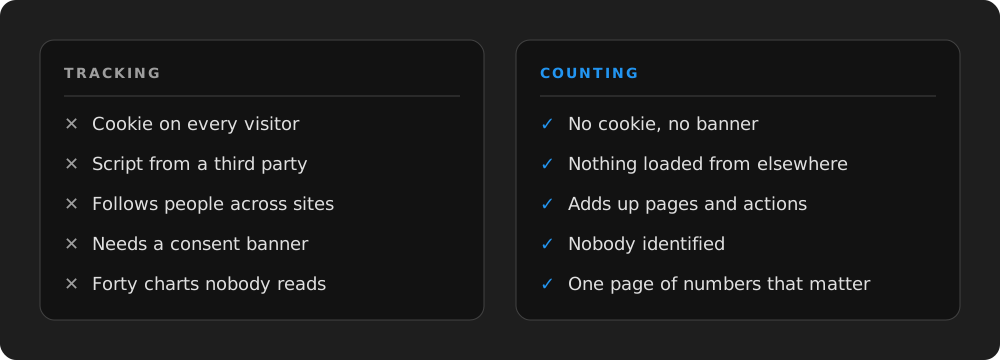
There is a bonus that owners rarely expect. A site that sets no cookies and loads nothing from a third party does not need a cookie banner at all, because there is nothing to consent to. The banner disappears, the site loads faster, and visitors arrive on your page instead of a wall of buttons. In our experience that alone does more for enquiries than any amount of analysis.
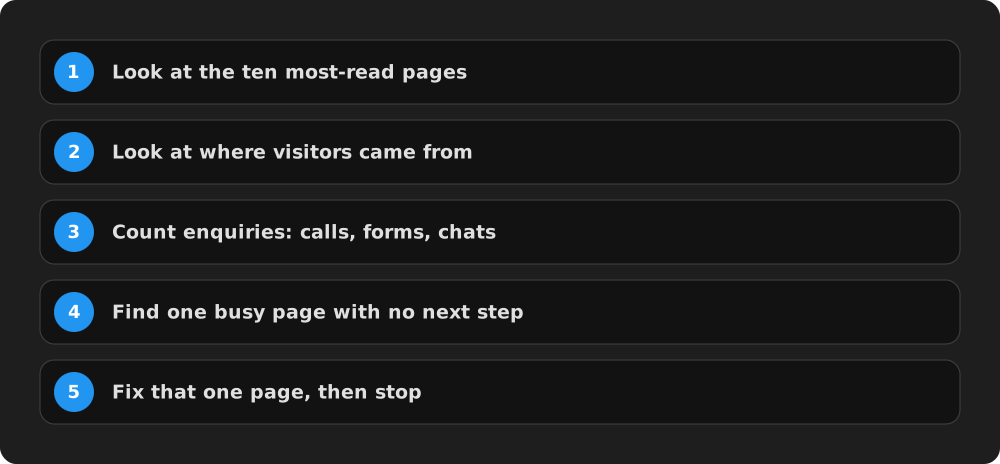
Once you are counting honestly, here is what to look at, and how often. Once a month is enough for most businesses. Once a week if you are running a campaign or have just launched something.
| Number | What it tells you | What to do about it |
|---|---|---|
| Visits per page, top ten | What people want from you | Make those pages the best on the site |
| Visitors by source | Which efforts bring people | Do more of what works; drop what does not |
| Enquiries per month | Whether the site earns its keep | Compare month on month, not day on day |
| Enquiries divided by visits | Whether the pages persuade | If it falls, a page has gone wrong |
| Pages with visits but no next step | Where people get stuck | Add a clear way to ring or ask |
The most useful of these is the last one. A page that is read often but never leads to a call, a form or a chat is telling you something. Perhaps the phone number is not on it. Perhaps it answers the question so well that people do not need to ask, which is fine for a page about your hours and not fine for a page about your services. Perhaps it is confusing. Whatever the reason, it is a page you can fix, and you would never have found it from a chart of total visits.
Some numbers feel important and are not. Total visits is the worst offender. A thousand visits from people who left in two seconds is worth less than fifty from people who rang. Bounce rate sounds alarming and usually means somebody found what they needed on the first page and left satisfied. Time on page is a guess dressed up as a fact. Real-time visitor counters are a toy. And any number that tries to tell you the age, gender or interests of your visitors is a guess made by a company that has been following them around, and you are better off without it.
Fifty visitors who rang are worth more than a thousand who did not.
Ignore, too, any number you cannot act on. If knowing it would not change what you write, what you fix, or where you spend your time, it is not measuring anything. It is just counting for the sake of it.
If your site currently carries a tracking script, ask whoever looks after it what it is for and whether anyone reads the reports. If the honest answer is no, ask for it to be removed, along with the banner it requires. Then ask for the simple counts instead: pages, sources, enquiries. Any competent host can provide them from the server's own records.
Then do the ten-minute check above once a month, write the enquiry count on a piece of paper, and watch it over a year. That single line, rising or falling against what you changed on the site, will teach you more about your website than any dashboard. We give our clients exactly these counts and nothing more, not because the fancy version is hard, but because the honest version is what a small business can actually use.