Software
Who actually writes it?
AI drafts, a separate review decides
A person decides what is built. Every change is independently reviewed and tested before it ships.
Anyone can ask AI for an app. Making one that is safe, that fits your business and that grows with it takes specialists. We are the AI specialists, for businesses anywhere in the world.
Turn it into a
Every business has a spreadsheet like this one. Press a button to see what replaces it.
| A | B | C | D | E |
|---|---|---|---|---|
| Mrs Okafor | 09:00 | Cut+colour | 65 | paid |
| D. Whitlow | 10:30 | Trim | 18 | ?? |
| same lady | 12:00 | colour | 65 | cash? |
| Priya (resc) | 2pm | Cut | 22 | paid |
| 15:15 | Beard | 12 | unpaid | |
| J Mensah | 16:00 | Cut+beard | 30 | paid |
Today
Tuesday, 6 jobsOutstanding
3 overdueBelow minimum
reorder before FridayBuilt by the same people with the same tools. Most are free, so try one now.
Secure and very fast, and hosted by us.
We build both, on a base already written and tested.
Built around your business today, and changed as your business changes. A fixed quote in writing, with a completion date.
What we buildHosting, contact form and live chat included. No cookies, no consent banner.
What comes with oneAsking AI for an app is the easy part. Knowing what it got wrong is the job.
The repetitive part takes minutes of machine time, not weeks.
Every change goes through 42 separate checks before it ships. Every finding is fixed, even the ones that look minor, because a few minor faults put together can make a serious one.
If we misjudge how long it takes, that is our problem, not yours.
In your own words. No specification needed.
Fixed, with a completion date, in writing.
Log in early and say what is wrong.
The code and the data are yours.
Twenty-five answers in five topics, in plain words.
AI drafts, a separate review decides
A person decides what is built. Every change is independently reviewed and tested before it ships.
Yes, in full
With plain documentation and an export for everything. If we walked away tomorrow, somebody else could pick it up.
Written down, with a completion date
The quote is agreed before work starts. It changes only if you ask for something that was not in your description, and we tell you first.
You take everything
All exportable, and no notice period. For software, the code and data are yours in full.
No, nothing to consent to
There is nothing to consent to. We set no cookies and collect no personal data.
Global, and it makes no difference
Registered in England and Wales, with everything done remotely. Where you are makes no difference to how quickly we answer.
No specification needed, and usually an answer back the same week.
Tell us what you need"Plumber near me." "Best café near me." "Dog groomer open Saturday near me." A large share of the searches a small business ever gets found by have those two words on the end, or something like them. It used to be a search engine that answered. Now it is just as likely to be an AI assistant on a phone, and the assistant does not show ten results. It picks two or three and says their names.
Being one of the names it says is not magic and it is not a trick. It comes down to whether your website, your map listing and the rest of the web agree about where you are, what you do, and whether people like you. This post covers the things that matter, and the things that will hurt you if you try them.
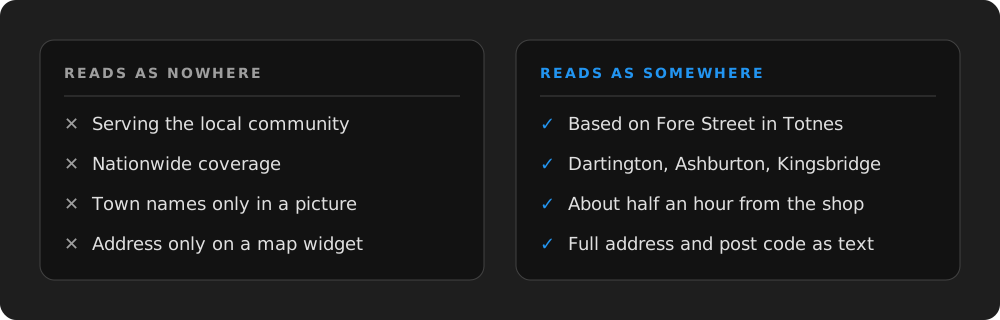
An assistant working out whether you are near someone reads the words on your pages. If your town is only in a picture of your shop sign, or only in the footer in tiny grey text, or only on a map that loads from somewhere else, you might as well be nowhere. Write it down, in ordinary sentences, on the pages that matter.
That means the home page says which town you are in. The contact page has the full address as text, including the post code. The about page says where you started and where you are now. Service pages say where you do that service. "We fit kitchens in Stroud and the villages around it, from Painswick to Nailsworth" is a sentence a machine can use. "Serving the local area" is not.
Most tradespeople and many services cover more than one town. Say so, and name them. A short list of the places you are happy to travel to is one of the most useful things on a small business website, and one of the rarest. Do not guess or exaggerate. If a town is an hour away and you would only go for a big job, either leave it off or say that.
Your free business listing on Google, and the equivalents on Apple and Bing maps, are probably the single biggest factor in whether you come up for "near me". Assistants lean on them heavily because they are structured: a name, an address, hours, a phone number, a category, reviews. If you have not claimed yours, do it this week. If you have, check it.
What matters most is that the details match everywhere. The same name, the same address written the same way, the same phone number, the same hours. If your website says "J. Smith Plumbing" and the map says "Smith's Plumbing and Heating" and a directory says "JS Plumbing Ltd", the machines are not sure they are the same business and trust all three less. Pick one way of writing everything and use it everywhere.
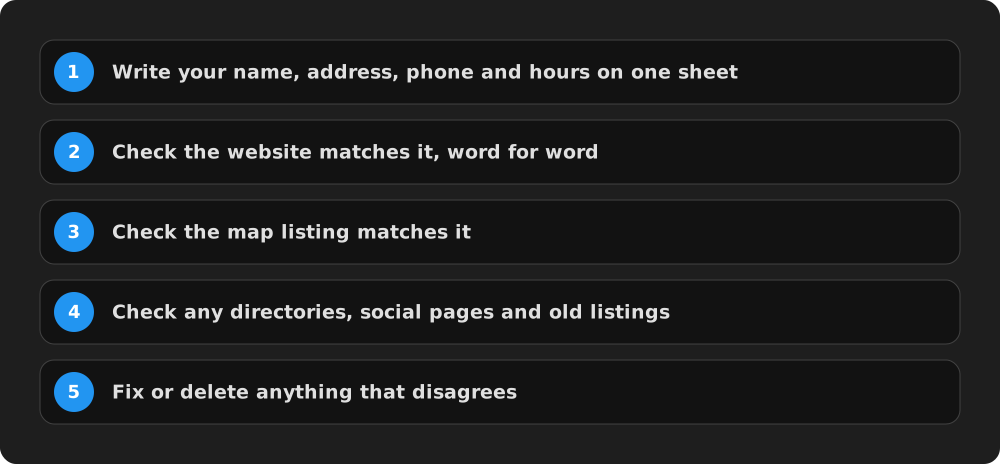
Old listings are the usual culprit. A directory you signed up to years ago with a previous phone number is still out there telling assistants the wrong thing. Search for your business name and go through the first few pages of results. Anything wrong, correct it or ask for it to be removed.
Assistants are asked for the best, not just the nearest. "Best" mostly means reviews: how many, how recent, how good, and what they say. A business with thirty reviews averaging four and a half, with the latest from last week, will be recommended over one with three reviews from two years ago, even if the second is better at the job.
The honest way to get reviews is to ask for them, one customer at a time, just after a job has gone well. Send a message with the link. Do not offer discounts for reviews, do not write them yourself, and do not buy them. Platforms are good at spotting all three, and the penalty is being quietly removed from results. Reply to the reviews you get, including the poor ones, calmly and briefly. Assistants read replies too, and a fair reply to a complaint says more about you than ten five-star ratings.
The machines are trying to work out whether you are real, nearby, and liked. Make all three easy to check.
If you cover a handful of towns, it can be worth giving each one a short page of its own. Not because it fools anyone, but because someone in each town has a slightly different question, and a page that answers it will do better than a general one. A good town page says what you do there, how far it is from your base, something true about the place, and perhaps a job you did nearby. Half a page of real information is plenty.
The line is easy to state: write a page for a town if you could stand in that town and honestly say "we work here". If you could not, do not.
Every trick for local search has been tried, and most now do more harm than good. In particular:
None of the honest work here takes long. An afternoon on the listing, an hour on the website, and a habit of asking happy customers for a line. We set up the place names, the areas list and the structured details on every site we build, and check the map listing matches. If you do the rest, you will be one of the names the assistant says out loud, which these days is worth more than a spot on page one ever was.